apprentissage continu

Install COCOON on your home screen

your personal tutor — L'Élan

Learning for the sheer joy of understanding, without pleasing any system.

No stressful grades, no cardboard diplomas, no classrooms that confine you. Just you, your curiosity, and an infinite guide.

0Explorers enrolled
0Conversations with L'Élan
0Epiphanies logged
0Stars across constellations
Rare experience

The Darkroom

Drop a photo — an object, a plant, a sky — and L'Élan reveals 3 hidden curiosities behind it.

Everything around you hides an untold story.

The tool

The Scribe

Photograph a page — a book, a note, a poster. L'Élan transcribes it, then you can explore it together.

JPEG, PNG or WEBP. The page is read, never stored.

Daily challenge

The Eyewitness

Watch the scene for 30 seconds… then test your memory of the most unexpected details.

Did you know?

Today · music

Jimi Hendrix never learned to read music and could not write down a single note, yet he is widely considered one of the greatest guitarists in history, composing entirely by ear and intuition.

Why?

Why does a second have exactly 9,192,631,770 oscillations?

Since 1967, one second has been defined by the number of times a cesium-133 atom vibrates between two energy states. This precise figure was chosen because it matched the old astronomical second almost perfectly, ensuring a seamless transition while giving science an atomic clock accurate to one second every 300 million years.

Myth or Reality?

Does lightning never strike the same place twice?

Myth. Lightning actively favors the same spots repeatedly. The Empire State Building is struck around 20 to 25 times per year. Tall, isolated, or conductive structures create ideal electrical pathways, making them recurring targets. The phrase likely emerged as a comfort, not a meteorological observation.

How does it work?

How does a maglev train float above its tracks?

Beneath a maglev train, powerful electromagnets create invisible cushions of repulsion, pushing the train away from the rails so it never actually touches them. Without friction, nothing slows it down except air resistance. The same magnetic forces that keep it floating also propel it forward, like a surfer riding a wave that travels along the track.

The Origin of…

Why do we call it a 'deadline'?

During the American Civil War, a 'dead line' was a physical boundary drawn around prison camps. Any prisoner crossing it was shot on sight. Newspaper editors later borrowed the term in the 1920s to mean the final limit beyond which a story could not be submitted, and the word quietly migrated into every workplace on earth.

The Tip of the Day

How can a single rubber band save you minutes every morning?

When drawers are full of tangled cables, finding the right one wastes precious time. Wrap each cable with a rubber band and tuck a small paper label underneath it before storing. This takes ten seconds per cable once, and eliminates the daily untangling ritual entirely. The label stays hidden until needed, keeping everything tidy without extra containers or cost.

The Word of the Day

To vellichor (v.)

To be struck by the strange wistfulness of used bookshops, where thousands of unknown lives once pressed against the same pages you now hold. Coined by John Koenig in The Dictionary of Obscure Sorrows, it captures that quiet ache of borrowed time. She vellichored through the dusty shelves, haunted by readers she would never meet.

The Paradox of the Day

The illusion of explanatory depth

Ask someone how a zipper works, and they will confidently say they understand it. Ask them to explain it step by step, and they will quickly falter. We confuse recognizing something with truly knowing it, mistaking familiarity for understanding. This gap, invisible until tested, reveals how our minds silently borrow confidence from the world around us rather than building it from within.

The Astonishing Number

A single second contains more moments than atoms in a grain of sand

Physicists define the Planck time, the smallest meaningful unit of time, at about 5.4 × 10⁻⁴⁴ seconds. One ordinary second holds roughly 10⁴³ of these intervals. That is more than the number of atoms in ten thousand grains of sand, meaning every blink of an eye spans an almost incomprehensible architecture of time.

Guess Before You Know

How many years does a single drop of water spend locked inside a glacier before reaching the ocean?

Take a guess before reading on. The answer is up to 10,000 years. A droplet trapped in the Antarctic ice sheet can remain frozen since the last Ice Age, slowly compressed under kilometers of ice, before finally melting and joining the sea. Ancient water is flowing through our oceans right now.

The Unexpected Connection

What do termite mounds have to do with modern skyscrapers?

Termite mounds in Zimbabwe maintain a near-constant internal temperature of 31°C despite outside swings of 40°C, achieved through a network of self-regulating air shafts. Architect Mick Pearce studied this system to design the Eastgate Centre in Harare, eliminating conventional air conditioning entirely. The building uses 90% less energy than comparable structures, proving that a 30-million-year-old insect solved a problem engineers are still learning to master.

The Quote to Ponder

"Imagination is not a talent of some men but is the health of every man." — Ralph Waldo Emerson

Emerson suggests that imagination is not a rare gift reserved for artists or geniuses — it is a vital sign of a healthy mind, as natural as breathing. We often wait for inspiration as if it belongs to others. What if you treated your imagination less like a luxury and more like a daily necessity?

transmission

A master, a disciple, and the thread that binds them.

Learning isn't filling a vessel, it's lighting a fire. Here, knowledge is passed on like a shared walk on a beach — unhurried, ungraded, until it melts into the horizon.

The manifesto of L'Élan.

Zero Border

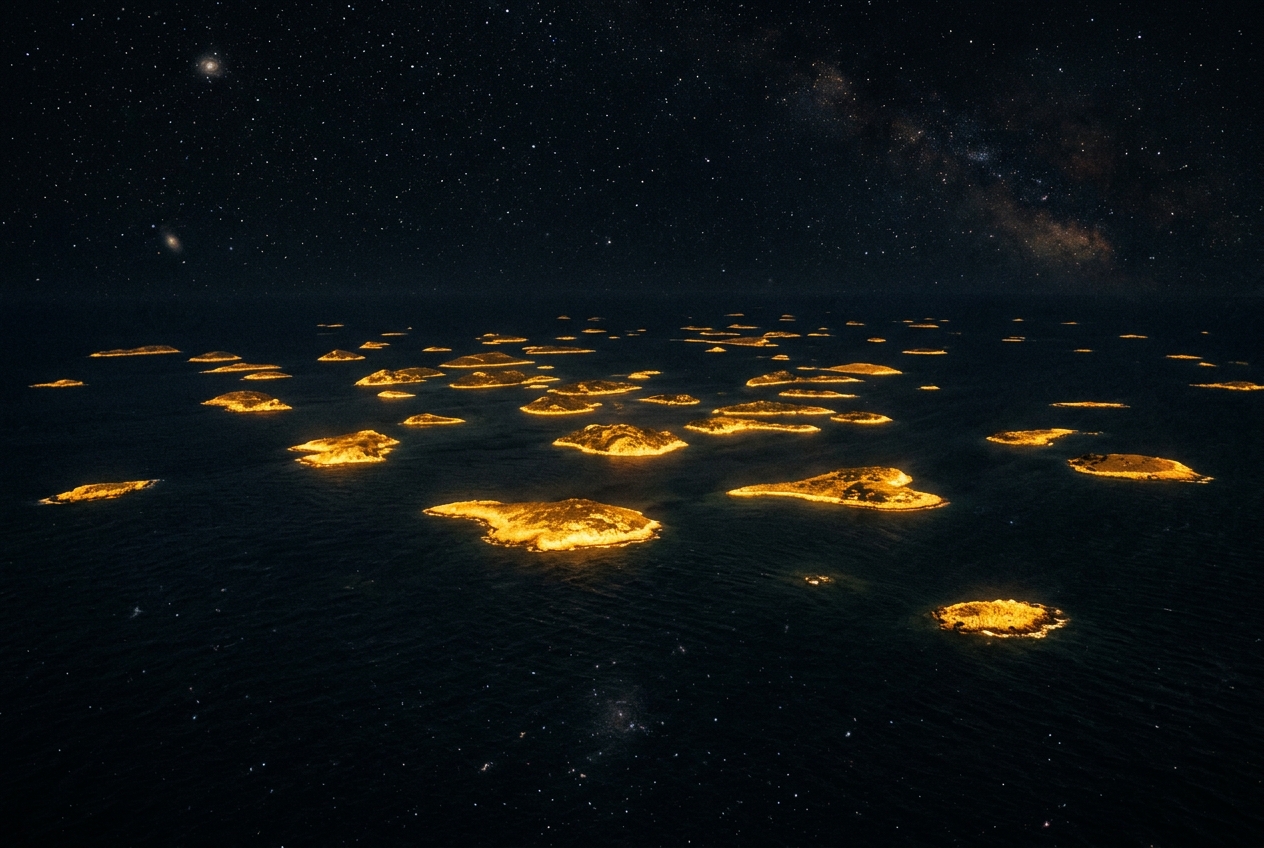
No levels, no classes. You wander through knowledge like an archipelago — quantum physics at 10, Greek philosophy at 10:15.

Zero Grading

We don't grade you. We ask: what struck you most in what we just explored?

Zero Destination

The goal isn't to finish a program — knowledge never ends. We feed your obsession of the moment.

Zero Elite

No star-student badges, no trophies. Your only engine is your intrinsic curiosity.

the five inner compasses

Cocoon's cardinal values

In the outside world, we advance through harshness and evaluation. Here, we journey through gentleness and patience.

Wonder

Unconditional Curiosity

The primary fuel: asking "silly" questions, exploring with no immediate payoff, letting the world surprise you. We don't seek to know in order to possess, but for the sheer joy of wonder.

The joy of not knowing

Intellectual Humility

Accepting to begin in the fog. Saying "I don't know, explain it to me" isn't a weakness — it's the first brave step of any great discovery.

Self-compassion

Kindness to Yourself

Dropping the whip of toxic productivity. If the mind tires, you stop. You honour your own biological and mental rhythm, with complete peace of mind.

Autonomy

Wandering Boldness

The freedom to carve your own path off the beaten track. Refusing rigid programs and external validation. You are the sole sovereign of your intellectual journey.

Constancy

Gentle Perseverance

Regularity is born not from constraint, but from love of the gesture: opening your cocoon a little each day, simply to pull a new thread.

we forget the codes of school

The Program

The Drift

You pull a thread and see where it leads you.

The Exam

The Mirror

A friendly chat where you explain the concept in your own words.

The Ranking

The Calm

No comparison. Your only benchmark is yourself of yesterday.

The Teacher

The Companion

An AI that admits when it doesn't know and searches with you.

ten good reasons

Why join COCOON

01

Zero grades

Learn without fear of being wrong.

02

Zero syllabus

You follow your curiosity, not a schedule.

03

A tutor of your own

L'Élan adapts to your pace.

04

The joy of understanding

Every exchange reopens a question.

05

Everything is connected

Your Constellation weaves your knowledge.

06

Your "Eureka" kept safe

Your Book of epiphanies.

07

In your language

EN · FR · ES · NL.

08

Listen instead of read

L'Élan's Voice & your podcasts.

09

Explore through images

Upload a photo, an artwork.

10

A gentle habit

Your curiosity streak, no pressure.

Conference of the month · Septembre 2026

Registrations open

The conference starts in

September 17 at 06:00 PM

53d
04h
22min
59s
L'aristocratie du temps

L'aristocratie du temps

Le temps libre et l'attention profonde à l'ère de l'intelligence artificielle

0 registered

L'« aristocratie du temps » appliquée à l'intelligence artificielle désigne un enjeu philosophique, économique et sociologique majeur : la redistribution de la ressource la plus rare et la plus précieuse du XXIᵉ siècle — le temps libre et l'attention profonde. Alors que l'IA promet de décupler notre productivité et d'automatiser le travail répétitif, la question fondamentale reste : qui bénéficiera réellement de ce temps libéré, et comment sera-t-il employé ?

I

La promesse historique vs la réalité de l'accélération

Historiquement — de John Maynard Keynes aux utopies technologiques du début du XXᵉ siècle — l'automatisation devait faire de chaque citoyen un « aristocrate du temps » : une personne affranchie du labeur mécanique, capable de consacrer ses journées aux arts, aux sciences, au débat citoyen et au loisir contemplatif.

En réalité, l'IA et le numérique ont souvent produit l'effet inverse.

  • L'accélération de l'exigence : au lieu de travailler moins, nous produisons plus et plus vite pour maintenir les mêmes standards.
  • La fragmentation cognitive : le temps libéré par les outils d'IA est immédiatement réabsorbé par la surconsommation d'informations, la réactivité permanente et l'économie de l'attention.
II

La nouvelle fracture sociale du temps

À l'ère de l'IA, la maîtrise du temps devient le principal marqueur d'inégalité sociale.

L'« Aristocratie » du temps

Possède l'autonomie d'agenda, la capacité d'interrompre le flux, d'exercer une pensée lente (Slow Thinking), la création complexe et l'esprit critique. L'IA est à son service comme levier stratégique.

Le « Prolétariat » temporel

Soumis au rythme des algorithmes, à l'urgence continuelle, au suivi métrique automatisé et au traitement de micro-tâches générées par la machine.

Le vrai luxe moderne n'est plus la possession matérielle, mais la capacité d'être indisponible, silencieux et concentré.

III

Les trois défis pour devenir un « aristocrate du temps »

  • Passer du gain de temps au temps à soi : le travail d'exécution délégué à l'IA doit servir à restaurer des espaces de réflexion profonde, et non à charger davantage les journées.
  • Sortir de la boulimie algorithmique : reconvertir la productivité en érudition, création ou repos, plutôt qu'en consommation passive de contenu hyper-optimisé.
  • Préserver l'effort cognitif désintéressé : la pensée complexe, la philosophie, la flânerie et le doute créatif restent des prérogatives humaines que l'IA ne peut ni remplacer ni accélérer sans en altérer la nature.

The open question

Pensez-vous qu'à titre individuel ou professionnel, l'IA vous a déjà permis de regagner du temps pour de la réflexion profonde, ou a-t-elle plutôt accéléré votre rythme quotidien ?

The next conference

Octobre 2026

Le krach du mérite

Novembre 2026

Le Confident Numérique

Speak up

Live on September 17 at 06:00 PM

The live starts in

53d
04h
22min
59s

The live chat opens on the day of the event.

Life around the fire

What is the campfire?

At COCOON, you never learn alone in your corner. The campfire is the warm place where curiosities meet — no grades, no judgment, just the joy of thinking together.

The Campfire

A peaceful community wall: drop a spark, a question or an epiphany, and discover those of other explorers. You come back to it like you'd come back to sit by the embers.

The Circle

A live shared campfire: invite a friend (or several) with a simple link, and explore the same topic in real time with L'Élan. Two minds, one flame.

A word by the campfire

A word from the founders

Audio in French

Coming soon

The Garden of Ideas

A box where project ideas sprout. Share yours, and help others grow by voting.

Be the first to plant an idea 🌱

logic, differently

The Mind Game

Gamification in the service of logic: elegant grids that strengthen reasoning and deduction — no timer, no score, just the joy of the click.

Gamification in the service of logic: elegant grids that strengthen reasoning and deduction — no timer, no score, just the joy of the click.

Takuzu

Premium

0s and 1s, never three in a row, as many of each per row and column.

Rikudo

Premium

Link consecutive numbers into one continuous path across the hexagons.

Nonogram

Premium

Reveal a hidden picture by filling the right cells from the clues.

Hitori

Premium

Shade cells so no number repeats in any row or column.

Light Up

Premium

Light every cell with bulbs, without any two dazzling each other.

Hashi (Bridges)

Premium

Connect the islands with bridges into one single connected network.

Masyu

Premium

Draw one flowing loop that respects the black and white pearls.

Build deduction. Pleasure without pressure. Understand, then play.

critical thinking in action

The Arena

5 open debates this month. School vs Cocoon — your call.

Debate 01

Can we learn without grading?

School

« Without marks, tests or report cards, how do we know we're progressing? Measurement and sanction are needed to push ourselves and guarantee an equal level of excellence for all. »

Cocoon

« A grade doesn't measure intelligence — it measures conformity and breeds anxiety. Real progress isn't measured on a 0-to-20 scale, but in the clarity with which a mind understands a concept and delights in explaining it. »

33% · SchoolCocoon · 67%

3 votes

For or against?

What the community thinks, debate by debate.

01Can we learn without grading?

1

School

33%

2

Cocoon

67%

3 votes

02Impose a curriculum, or follow curiosity?

3

School

75%

1

Cocoon

25%

4 votes

03Should learning prepare for a job or for a life?

0

School

0%

4

Cocoon

100%

4 votes

04Split subjects, or connect knowledge?

0

School

50%

0

Cocoon

50%

Be the first spark to vote.

05Effort through constraint, or effort through pleasure?

1

School

50%

1

Cocoon

50%

2 votes

stay in the current

The Weekly Drift

A spark of curiosity every week: a surprising fact, a topic to explore, an epiphany from the community. Never any pressure.